
World Sport
Karate Federation

A Division of Born To Win Athlete Development Pathway, Inc.
(WSKF)
Safety, Integrity, and Excellence in Martial Arts Competition
United Through Excellence — Empowered Through Competition
Founded in 2025 under the Born To Win Athlete Development Pathway, Inc. (501(c)(3)),
the World Sport Karate Federation (WSKF) was created to unify martial artists worldwide through a modern, inclusive, and professionally structured federation. Rooted in the Born To Win philosophy, WSKF brings together the diverse legacy of Japanese, Korean, Chinese, and Polynesian martial arts under a system that prioritizes safety, education, and long-term athlete development.
WSKF provides a complete range of competition divisions across Kata / Forms, Weapons, Point Sparring, Continuous Sparring, and the Creative Forms Circuit (CFC). These divisions are designed to develop well-rounded martial artists with strong technical ability, creativity, timing, discipline, control, and performance quality. Kata and Forms divisions highlight traditional lineage, modern expression, musical performance, and weapons proficiency, while Sparring divisions focus on timing, strategy, distance management, technical excellence, and safe controlled-contact application.
Unlike fragmented or outdated circuits, WSKF offers a clear, structured pathway that supports athletes of all ages and skill levels — from grassroots practitioners to international champions. The federation empowers schools, instructors, and promoters to collaborate within a unified global framework built on integrity, accessibility, and technical mastery.
Together, we are shaping the future of martial arts competition — unified, disciplined, and Born To Win.
KATA / FORMS DIVISIONS
-
A choreographed form performed to music. Athletes are evaluated on synchronization, rhythm, martial technique, and creative expression.
-
A weapons performance coordinated to music. Judging focuses on timing, control, originality, difficulty, and connection to the musical structure.
-
An open-style division where athletes design their own form. Movements may blend traditional technique with athletic, modern, or innovative creative elements.
-
Kata from recognized Japanese systems such as Shotokan, Goju-Ryu, Wado-Ryu, and Shito-Ryu. Evaluation emphasizes rhythm, power, timing, stances, and purity of classical Japanese technique.
-
Forms from Korean traditions such as Taekwondo and Tang Soo Do. Judges assess balance, precision, power, and consistency with traditional Korean form structure.
-
A dynamic weapons division connected to the CFC Creative Form Circuit – Extreme Division.
Athletes may incorporate advanced spins, releases, aerial transitions, and high-difficulty sequences while maintaining control and proper martial intent.
Judging focuses on originality, difficulty, weapon handling, showmanship, and overall performance quality. All weapons must pass equipment inspection before competition.
-
First to 5 points wins.
Scoring: 2 points = kicks above the waist | 1 point = all hand techniques.
No face contact.
1st offense = warning. 2nd = disqualification.
Automatic DQ if blood is drawn
-
First to 5 points wins.
Scoring: 2 points = kicks above the waist | 1 point = all hand techniques | 1 point = groin strike (groin is an open target).
No face contact.
1st offense = warning. 2nd = disqualification.
Automatic DQ if blood is drawn.
Sweeps allowed (1 point per sweep).
-
2 rounds × 2 minutes each.
No stop-and-go scoring (judges tally throughout).
Two judge’s score: Judge 1 tracks Competitor A’s points, Judge 2 tracks Competitor B’s points.
Winner = most points after both rounds.
-
Duration: 2 minutes.
Winner = most points accumulated.
Scoring:
1 point = hand techniques
2 points = kicks above the waist
3 points = spinning kicks
Face shield required. Light contact to facial/headgear allowed.
7-point spread rule: If one competitor leads by 7, the match ends immediately.
-
Judges score between 1 and 10 (1 = lowest, 10 = highest).
The lowest total score is 4, and a perfect score is 40.
Each judge has a dedicated focus area:
Stance Judge – evaluates only stances.
Kick Judge – evaluates only kicks.
Strikes Judge – evaluates only strikes.
Overall Judge – evaluates intensity and overall performance; serves as tiebreaker.
KOBUDŌ (TRADITIONAL OKINAWAN WEAPONS FORMS) – RULES
Division Overview
The Kobudō division is limited to traditional Okinawan weapons forms, performed in a solo kata format. This division emphasizes control, precision, balance, and traditional technique. All performances are non-contact.
-
Only traditional Okinawan Kobudō weapons are allowed, including but not limited to:
• Bō (long staff)
• Sai
• Tonfa
• Nunchaku
• Kama
• Eku / Eiku (oar)
• Tinbe & Rochin (shield & spear/knife)
-
The following are not permitted in the Kobudō division:
• Katana or Japanese swords
• Iaido / Iaijutsu / Battojutsu
• European or modern swords
• Fantasy, theatrical, or non-traditional weapons
-
• Solo performance only
• One continuous form per entry
• No contact with other competitors or objects
• Time limits may be enforced by the event director
-
• Weapons must be secure and competition-safe
• Live blades are not permitted
• Loss of weapon control, unsafe handling, or dangerous behavior may result in score deduction or disqualification
-
Competitors are evaluated on:
• Technical accuracy and weapon handling
• Control, balance, and body mechanics
• Timing, rhythm, and transitions
• Traditional correctness and intent
• Overall presentation and composure
-
The Head Judge and Tournament Director retain final authority on rule interpretation, safety decisions, and disqualifications.
SWORD ARTS (IAIDO / JAPANESE SWORD FORMS) – RULES
Division Overview
The Sword Arts division is reserved for Japanese sword forms, including Iaido and related sword disciplines, performed in a solo, non-contact format. This division is separate from Kobudō and follows sword-specific performance standards.
-
• Iaitō (unsharpened metal sword)
• Bokutō (wooden sword)
• Other approved training swords as permitted by event policy
-
• Sharpened blades
• Live cutting demonstrations
• Fantasy or non-traditional swords
-
• Solo performance only
• One continuous form per entry
• No contact with other competitors or objects
• Controlled drawing and sheathing at all times
-
• All sword handling must demonstrate full control and awareness
• Unsafe drawing, loss of control, or reckless behavior results in immediate disqualification
• Protective gear may be required based on event policy
-
Competitors are evaluated on:
• Precision of drawing and re-sheathing
• Control, posture, and balance
• Timing, rhythm, and flow
• Awareness, focus, and composure
• Traditional execution and intent
-
The Head Judge and Tournament Director retain final authority on equipment approval, safety determinations, and final scoring.
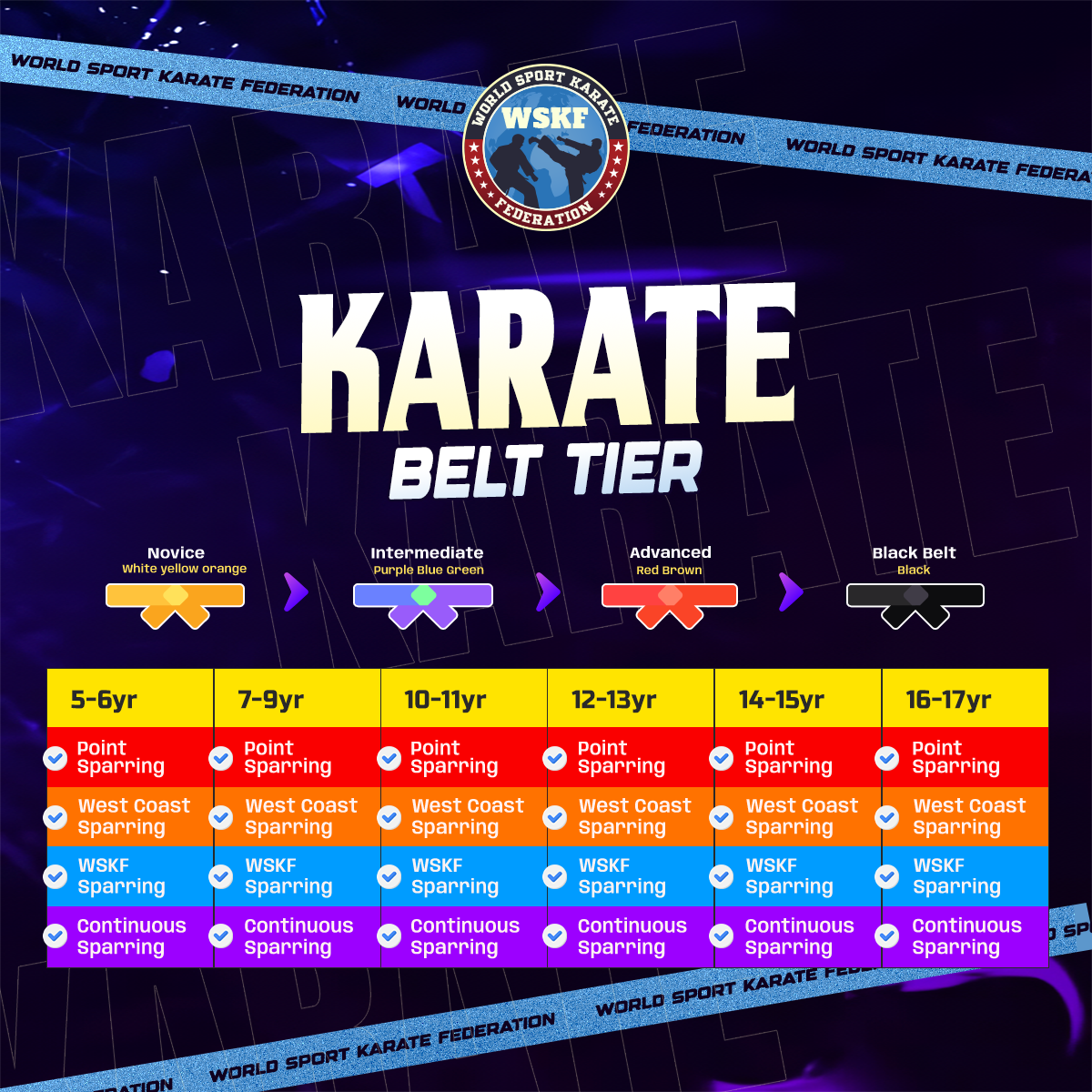
Rules & Regulations
Stances Criteria
Proper hand placement
Direction of feet
Weight distribution
Transition
Fluidity
Kicks Criteria
Height of kicks
Chamber and recoil
Accuracy and direction
Transition
Fluidity
Strikes Criteria
Chambers
Speed
Power
Accuracy and direction
Transition
Fluidity
Overall & Intensity
Judge with the highest knowledge and experience.
Assesses intensity and overall demonstration.
Decides results in case of ties.
NOTE FOR ALL KATA / FORMS DIVISIONS
Final rules, contact levels, and scoring criteria for every division will be reviewed and confirmed during the Official Rules Meeting before competition begins.